The Republican Education Platform for 2012


The silly season of politics is upon us.  In an effort to do my part, I am going to endeavor, here, to provide an overview of the two parties’ education platforms.  My disclaimer is that I am digging through the political-speak to try to figure out what each party actually wants to DO with respect to education, so I encourage you to read the platforms yourself for the whole story.  For all of my international readers, I imagine this will be quite interesting for you! I will review the RNC platform today and the DNC platform tomorrow.

RNC Education Platform 2012

Advancing Americans with Disabilities
Supports:

  • IDEA
  • Preventative efforts in early childhood education, especially in pre-reading

Education: A Chance for Every Child
Supports: Continue reading

Posted in Uncategorized | Tagged , , , , , , , , , , , , , , , , , | 3 Comments

U.S. Schools with the Best Technology…and Everything Else


Ever wondered about this?  I don’t know what got me thinking about it, really, but I started wondering about technology in Department of Defense schools.  Maybe it’s because it’s Labor Day weekend and I always associate Labor Day with Memorial Day (sort of an alpha and omega thing).  And of course, Memorial Day with the military.  So I just thought I would do a little poking around…I hadn’t really thought about this before.

It turns out that Department of Defense Education Activity (the full name!) schools are, as a group, probably the best funded and best outfitted public schools that we have.  There are 194 DODEA schools serving over 93,000 students worldwide.  And DODEA schools are way ahead of regular public K12 schools in the US when it comes to technology implementation. Continue reading

Posted in Global, Technology | Tagged , , , , , , , , , , , | 15 Comments

Motion Math Fractions App Works!


Friday a colleague sent me a research study…I was super excited because it’s an effectiveness study for an app that has been getting a lot of attention recently, Motion Math.

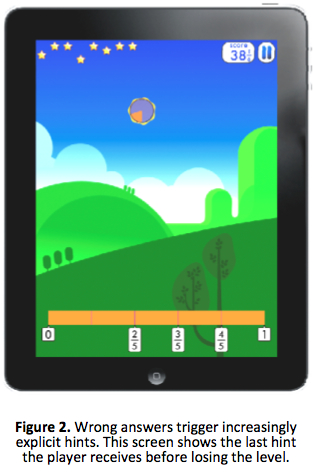
Before reading the research study, I bought the app myself and reviewed it for instructional design features and functions that I think are important.  I was quite pleased with the app.  It has feedback for every learner response, levels up when the learner does well, and remediates when the learner makes mistakes (see image at right and caption).  The user interface was nice and clean, without distracting elements that are irrelevant to the learning task.  It was also easy to use, the required learner response being pretty intuitive and including basic instructions. Continue reading

Posted in App Reviews & Recs, Instructional Design, Technology | Tagged , , , , , , , , , , , | 4 Comments

Intrinsic Motivation can be Aversive


A few days ago, a friend of mine, Matt Welch, wrote something on his blog that totally blew my mind.

There’s been so much conversation lately, on this blog and others, debating the use and value of intrinsic and extrinsic motivation (or reinforcers) in the classroom.  But what Matt brilliantly pointed out here was that we have only been discussing positive consequences:

“Setting aside whether or not the intrinsic vs. extrinsic motivation distinction is valid, another question comes up — why is it that we characterize programmed positive reinforcement as artificial and prone to undermine intrinsic motivation but the myriad of programmed negative reinforcement contingencies, punishment contingencies, and forms of mildly aversive control we utilize are not also characterized as artificial and thus undermining ‘intrinsic motivation’?” Continue reading

Posted in Learner Behavior | Tagged , , , , , , , , , , , , , , , | 13 Comments

The Scourge of Suspending Kids with Disabilities


I read an article in the NY Times this past week that made me really angry.  I don’t tend to get angry much….irritated, frustrated, outraged, yes, but not often angry.  Some of you may have seen the article, Suspensions Are Higher for Disabled Students, Federal Data Indicate.  I spent a lot of years in special ed, and these kids are close to my heart.

The fact that suspensions are higher for kids with disabilities isn’t really a big surprise.  But the fact that kids with disabilities are TWICE as likely to be suspended as their typically-developing peers and that black kids with disabilities are the most-frequently suspended (one out of every four black children with a disability is suspended at least once during the school year) was extremely disturbing to me.  One example given in the article is of the Chicago Public Schools where 63% of their black students with disabilities were suspended at least once in 2009-2010. Continue reading

Posted in Learner Behavior | Tagged , , , , , , , , , , , , | 5 Comments


Another great post from Pedro today that I wanted to share with all of you. In one fell swoop he uses research to dismantle the idea that there is such a thing as “digital natives” AND the notion that we should use different instructional design methods for different generations. Why write my own post today when this is so fantastic? Enjoy and happy weekend!

Pedro's avatarFrom experience to meaning...

First of all, for everybody who thinks that digital natives exist, do read this. But the real question is if different generations need different forms of instructional design. Many people do think this is the case, but what does research says?

Jeroen Janssen (@J3ro3J) tweeted this review by professor Thomas Reeves yesterday and although there are differences, the need for different approaches is not that certain to say the least.

From the conclusion:

“Although there are certainly many doubters, the consensus of scholarship and opinion is that there are generalizable generational differences that are worth taking into consideration in the “knowledge worker” or professional workplace and other contexts such as higher education. For example, there are differences with respect to attitudes, work habits, and motivators that anyone managing cross-generational teams should understand. Managers and workers should also be aware that generational differences in attitudes toward the balance between work…

View original post 136 more words

Posted in Uncategorized | 3 Comments

Goodbye Teacher


Last week I was reading a blog that discussed different teaching methodologies.  One of those methods was Programmed Instruction (PI), a method that was developed by B.F. Skinner.  PI dates back to the 1950s when Skinner developed his Teaching Machine. The idea behind PI was that delivery of an instructional program could be automated so that kids could work independently and at their own pace, and the program adjusted to their performance.  Not theoretically different from many of the adaptive learning software programs that are on the market today.

But what disturbed me in the blog was that someone commented that the purpose of PI was to eliminate the teacher.  I wasn’t surprised in one sense…PI has always been accused of replacing the teacher as the delivery system of critical information.  But I had never heard the accusation levied that this was the purpose of PI. Continue reading

Posted in Instructional Design, Learner Behavior | Tagged , , , , , , , , , , , , , , , | 3 Comments

Five Tips for Using Student Response Systems for Formative Assessment


This post originally appeared on the Promethean Planet community blog on May 17, 2012.   There are a few redundancies with another of my posts, Top 12 Best Practices for Clickers in the Classroombut the current post endeavors to focus specifically on using clickers for Formative Assessment.  Enjoy – KM

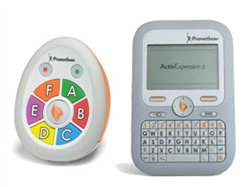
Whatever Student Response System (SRS) you are using in your classroom—e.g. Promethean’s ActiVote, ActivEngage or ActivExpression—these systems are ideal for conducting formative assessment. Not only do they provide the feedback that you need to adjust your instruction, but they save all of the student data automatically, allowing you to examine them more closely at a later time. Continue reading

Posted in Assessment, Technology | Tagged , , , , , , , , , , , , , , , , , | 2 Comments

Bizarro World: Is Algebra Necessary?


I had a whole other post planned for today, but it got bumped because yesterday I, like many of you, read the strangest op/ed piece that I think I’ve ever read in the NY Times.  And that’s saying something.  In the piece, Is Algebra Necessary?, author Andrew Hacker suggests, in a nutshell, that algebra is too hard to require it of students as widely as we currently do.  Dr. Hacker states that as many as six million high school students and two million college students daily struggle with algebra and asks, “Why do we subject American students to this ordeal?” Continue reading

Posted in Academics, STEM | Tagged , , , , , , , , , , , , , | 19 Comments

How to Choose Educational Apps?


I’ve been fooling around in the app store a lot lately.  Maybe I have too much time on my hands, but I find it fascinating to see what is out there in the educational app world. Continue reading

Posted in App Reviews & Recs, Technology | Tagged , , , , , , , , | 7 Comments